How to test a game idea before you build the whole game
Most game ideas sound great in a meeting. A few days of cheap prototyping tells you which ones are actually fun — before you spend months on art and code.
Every studio has a folder full of ideas that sounded brilliant and turned out to be dull once people played them. The good news is that you rarely need a full production to find out. A focused prototype can answer the most important question — is this fun? — in days rather than months.
Write down the one thing you are testing
A prototype is an experiment, and an experiment needs a question. Keep it to one sentence: "Is swiping to merge objects satisfying for more than five minutes?" or "Do players understand the twist without a tutorial?" Anything that does not help answer that question can wait.
Start on paper, or with grey boxes
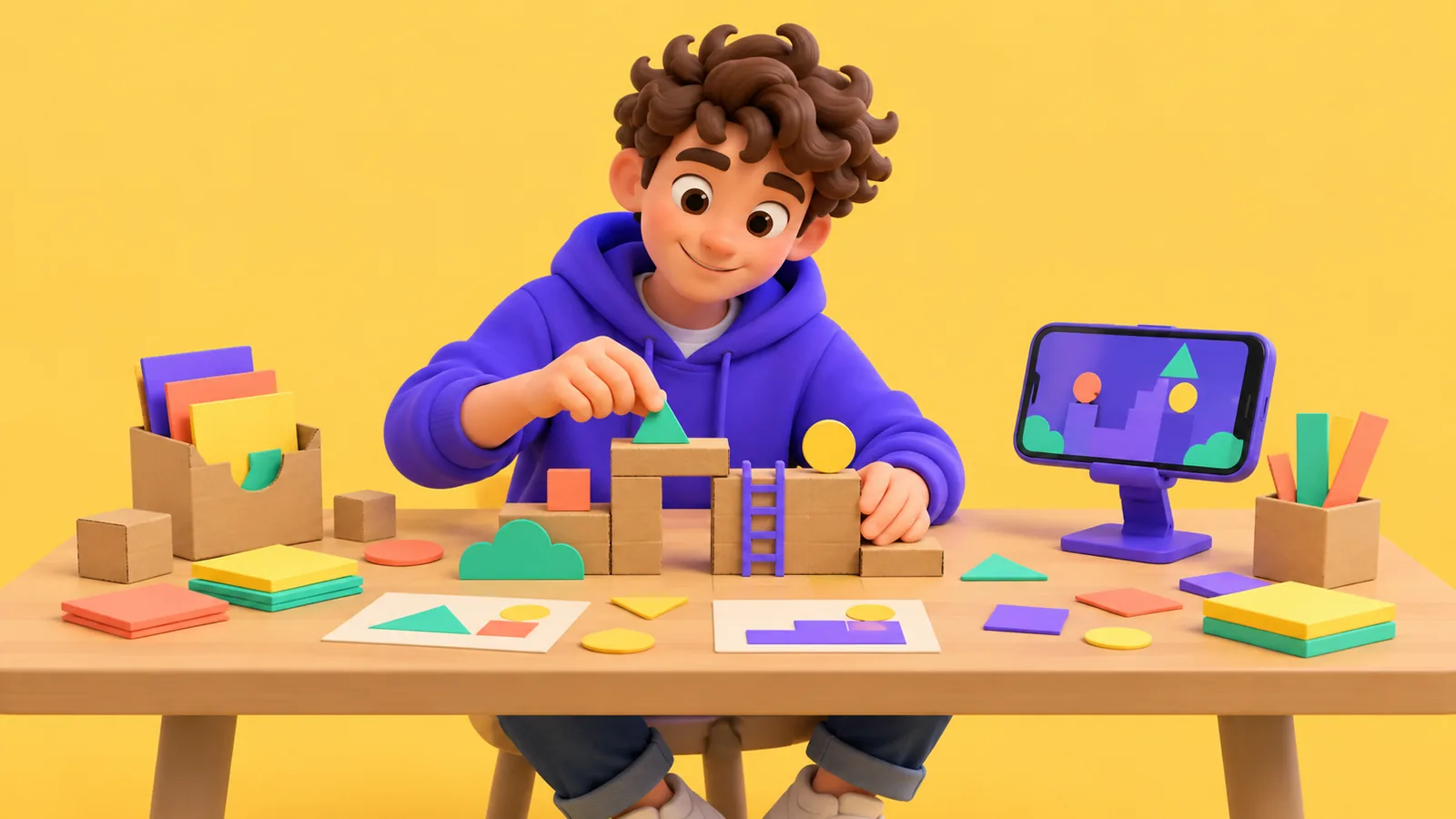
Many puzzle and strategy ideas can be tested with cards, coins and a pen. For action games, a few coloured boxes moving on screen are enough. Placeholder art is a feature, not a weakness: when nothing looks finished, testers comment on the mechanic instead of the colours.
Make it playable in a week
- One level or one short loop, not a menu system.
- No saving, no settings, no store.
- Just enough feedback that actions feel responsive.
If a prototype takes longer than about a week, the scope has usually crept. Cut it back to the core and try again.
Watch people play — and stay quiet
Hand the phone to someone who has never heard the idea and say nothing. Note where they hesitate, what they try that the game does not allow, and when they put the phone down. Their behaviour is far more honest than their opinion afterwards.
Decide what the result means
After a handful of sessions you will usually see one of three outcomes:
- Players keep going on their own. Promising — move to a vertical slice with real art.
- Something is fun, but not what you expected. Follow that thread in the next prototype.
- Nobody asks to play again. Archive it and celebrate the money you just saved.
Killing an idea after one week is a success, not a failure. Killing it after six months is the expensive version of the same decision.
Prototyping does not guarantee a hit, but it dramatically improves the odds — and it keeps the team's energy for the ideas that have earned it.